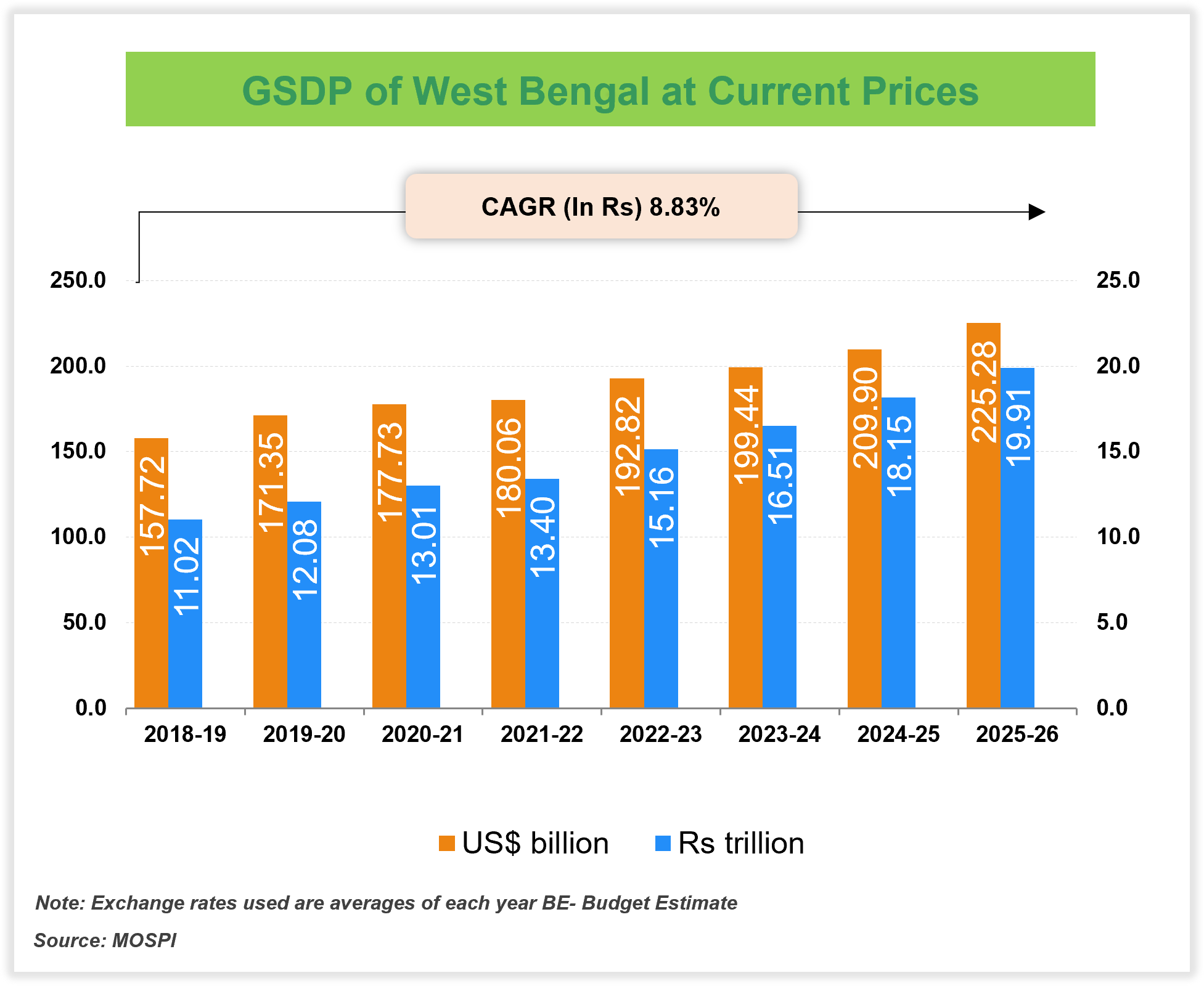
West Bengal, India’s sixth largest state in terms of economic size, at current prices, gross state domestic product (GSDP) is estimated at Rs. 199.09 trillion (US$ 2.25 trillion) in 2025-26. The average annual GSDP is estimated to increase at 9.70% from FY25 to FY26.
In FY26 the total exports from the state stood at Rs. 113876.26 crore (US$ 12.88 billion). West Bengal exported key items such as Engineering Goods and Gems and Jewellery.
As of March 2026, West Bengal had a total installed power generation capacity of 11,453.62 MW, of which 6,798.84 MW was under state utilities, 2,589.04 MW under private sector and 2,065.74 MW under central utilities.
Of the total installed power capacity 9,199.34 MW was contributed by thermal power, 1,483.30 MW by hydropower and 770.98 MW by renewable power.
According to Telecom Regulatory Authority of India (TRAI), the state had 58.11 million wireless subscribers and 67.47 million internet subscribers, as of March 2026.
West Bengal has abundant natural resources of minerals and suitable agro-climatic conditions for agriculture, horticulture, and fisheries. It is in vicinity to mineral rich states like Jharkhand, Bihar, and Odisha. It offers excellent connectivity to the rest of India in terms of railways, roadways, ports, and airports.
The state is the second-largest tea growing state in India. Total tea production in West Bengal stood at 347.59 million kgs in FY25 (April-December), accounting for 25.15% of India’s total production.
Between October 2019-March 2026, FDI inflows in West Bengal stood at Rs. 16,949.75 crore (US$ 2,137.03 million).
Some of the major initiatives taken by the Government to promote West Bengal as an investment destination are:
- In January 2026, Prime Minister Mr. Narendra Modi inaugurated, laid the foundation stone and flagged off development projects worth over Rs. 830 crore (US$ 93.92 million) in West Bengal. The projects included rail infrastructure initiatives and the launch of three new Amrit Bharat Express trains, aimed at strengthening connectivity and transportation infrastructure in the state.
- In 2026, West Bengal announced a maritime infrastructure pipeline worth Rs. 22,700 crore (US$ 2.52 billion), covering ports, coastal infrastructure, inland waterways and logistics projects across the state.
- As of FY26, 41,038.58 km of roads and 61 bridges had been sanctioned under the Pradhan Mantri Gram Sadak Yojana (PMGSY) since 2001, with cumulative funding of Rs. 21,433.48 crore (US$ 2.38 billion).
- In October 2025, Jindal India Limited commissioned a downstream steel facility in West Bengal with an investment of Rs. 1,500 crore (US$ 171.84 million), adding 0.6 million-tonne capacity and lifting its total annual output by about 60 % to 1.6 million tonnes.
- In July 2025, the West Bengal Government announced that the state has attracted Rs. 1,33,000 crore (US$ 15.38 billion) in private investment and generated 1.8 lakh jobs across sectors such as iron & steel, oil & gas/energy and logistics.
- The industrial sector in West Bengal grew by 7.3% in 2024-25, exceeding the national average of 6.2%.
- In March 2025, Haldia Petrochemicals Ltd (HPL) is exploring an investment of about Rs. 8,500 crore (US$ 973.77 million) in West Bengal for a new polycarbonate production plant.
- The state, by organizing eighth Global Summits, has so far received investment worth Rs. 23,94,595 crore (US$ 278.44 billion) in large industries.
- HDC Bulk Terminal Ltd (HBTL), a wholly owned subsidiary of Adani Ports and Special Economic Zone Limited (APSEZ), has signed the Concession Agreement with Syama Prasad Mookerjee Port, Kolkata (SMPK) for mechanization of Berth no. 2 at Haldia Port.
- In State Budget 2026-27 Rs. 10,463.12 crore (US$ 1.16 billion) has been allocated to Agriculture and Allied Activities of which Rs. 27,016 crore (US$ 3.00 billion) has been allocated for financial support to Krishak Bandhu and Rs. 3,938 crore (US$ 437.56 million) has been allocated for crop insurance.
- As per State Budget 2026-27 Rs 4.06 lakh crore (US$ 45.12 billion) has been allocated for Education, Sports, Arts, and Culture.
West Bengal is a major economic gateway to eastern India, the Northeast and Southeast Asia, supported by strong connectivity, rich natural resources and a large consumer base. With a projected GSDP of US$ 236.56 billion in 2025–26 and robust export performance led by engineering goods, gems and jewellery, tea and rice, the state combines industrial depth with agricultural strength. Competitive operating costs, expanding power capacity, rising digital penetration and steady FDI inflows underpin its investment appeal. Ongoing investments across steel, petrochemicals, logistics, tourism, urban development, healthcare and education, along with sustained infrastructure spending, are reinforcing West Bengal’s position as a diversified and fast-growing economic hub.