Advantage India
Robust
Demand
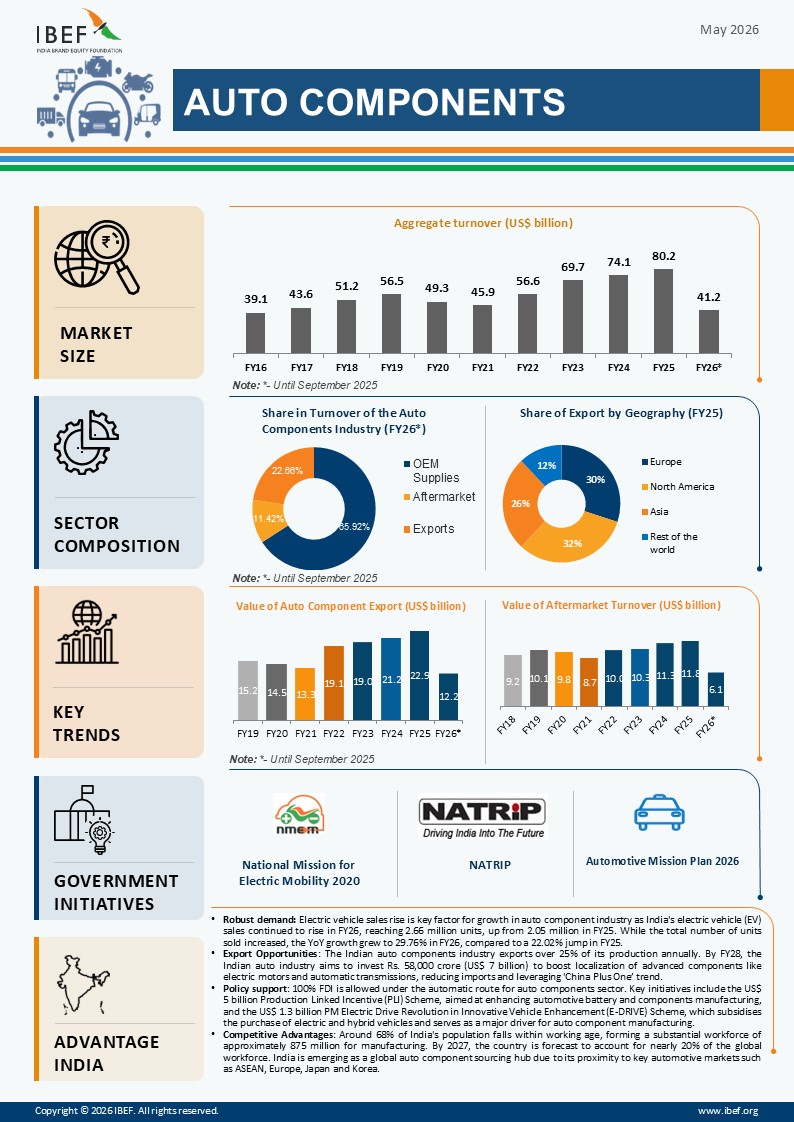
*Electric vehicle sales rise is key factor for growth in auto component industry as India's electric vehicle (EV) sales continued to rise in FY26, reaching 2.66 million units, up from 2.05 million in FY25. While the total number of units sold increased, the YoY growth grew to 29.76% in FY26, compared to a 22.02% jump in FY25.
*By 2030, ten million EVs could be sold each year. The EV market is expected to reach US$ 206 billion by 2030.
*Most of the components sold to OEMs are engine components (26%), body/chassis (14%), suspension & braking (15%), drive transmission & steering (13%), and electricals & electronics (11%) in FY25.
*India’s auto-component industry is poised to reach US$ 200 billion by 2030, supported by its cost competitiveness, skilled workforce, and growing domestic demand, according to a McKinsey report titled Shaping the future of India’s auto component industry.

Export
Opportunities
*Exports of auto components rose by 8%, reaching Rs. 1,95,726 crore (US$ 22.90 billion) in FY25, up from Rs. 1,81,196 crore (US$ 21.20 billion) in FY24.
*Amid evolving trade dynamics, India is increasingly recognised for its strategic advantages, positioning it as a reliable hub for anchoring businesses. This is driven by India's rapid economic growth, global integration, and leadership in five India-led corridors.
*The Indian auto components industry exports over 25% of its production annually. By FY28, the Indian auto industry aims to invest Rs. 58,000 crore (US$ 7 billion) to boost localization of advanced components like electric motors and automatic transmissions, reducing imports and leveraging 'China Plus One’ trend.

Policy
Support
*Key initiatives include the US$ 5 billion Production Linked Incentive (PLI) Scheme, aimed at enhancing automotive battery and components manufacturing, and the US$ 1.3 billion PM Electric Drive Revolution in Innovative Vehicle Enhancement (E-DRIVE) Scheme, which subsidises the purchase of electric and hybrid vehicles and serves as a major driver for auto component manufacturing.
*The GST on electric vehicles has been lowered from 12% to 5%, and the GST on chargers and charging stations for electric vehicles has been decreased from 18% to 5%.
*In January 2024, the Government of India approved additional fund of Rs. 1,500 crore (US$ 180.3 million) for second phase of FAME-II.
*100% FDI allowed under automatic route for the auto components sector.

Competitive
Advantage
*India ranked as the second most attractive hub in 2024, the country's manufacturing sector is projected to expand by 8% to 10% over the next 20 years, with value-added manufacturing anticipated to grow by 30% by 2030.
*India's competitive cost base, rising investments, and strong industrial foundation are set to drive annual GDP growth of 6% to 7% over the next five to seven years, establishing it as the world's third-largest economy by 2030.
*A cost-effective manufacturing base in India keeps costs lower by 10-25% relative to operations in Europe and Latin America.
*Second-largest steel producer globally, hence a cost advantage.
*India is emerging as a global auto component sourcing hub due to its proximity to key automotive markets such as ASEAN, Europe, Japan and Korea.


Related News
MOREAuto Component Clusters
- Maharashtra
- Tamil Nadu
- National Capital Region(NCR)
- Gujarat
- Madhya Pradesh

Posters
MORE
COMPONENTS OF QUALITY
India is emerging as the world's hub of choice when it comes to manufacturing quality auto components. The industry has over 600 manufacturers who exceed the world's most stringent quality standard.
IBEF Campaigns
MORE

Aatmanirbhar Bharat Utsav 2024
Union Minister of External Affairs, Dr. S. Jaishankar and Union Commerce an...
Case Studies
MORESUV Dominance and the Future of Passenger Vehicles

India's passenger vehicle industry over the past two decades have been gone under significant changes. In particular, the market has been transfor...
Expressway Infrastructure Development Outlook in India
India's vision of becoming a Viksit Bharat by 2047 has positioned transport infrastructure as a cornerstone of its long-term economic growth strat...
The Rise of Contract Manufacturing in India's Electronics Sector
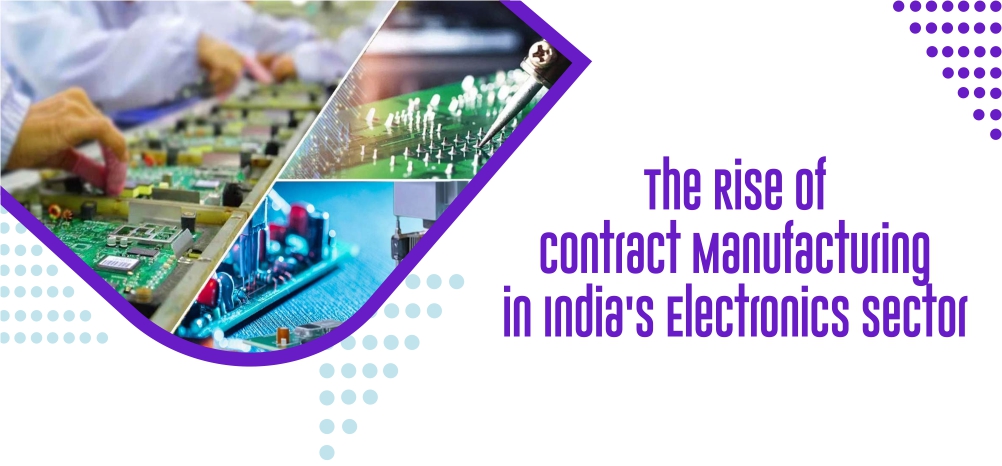
India's rise to become a large center for electronics manufacturing services is one of the most significant manufacturing changes in India's r...
IBEF BLOG
MORE
India's Premium Fresh Produce Exports: Creating New Opportunities for Farmers
India has emerged as a major exporter of horticulture crops owing to the pr...

India's Content Economy: Building Global Audiences Through Digital Entertainment
The digital entertainment ecosystem in India is currently experiencing a fu...

Popular Rice Varieties in India: Market Landscape, Key Varieties and Growth Opportunities
Rice is one of the agricultural products which is of importance in India, a...
Partners