Tamil Nadu is the fourth-largest state of India. It has a diversified manufacturing sector and features among the leaders in several industries like automobiles and auto components, engineering, pharmaceuticals, garments, textiles, leather, chemicals, plastics, etc. It ranks first among the states in terms of the number of factories and industrial workers.
Tamil Nadu Industrial Development Corporation Ltd (TIDCO), State Industries Promotion Corporation of Tamil Nadu (SIPCOT), Tamil Nadu Industrial Investment Corporation Limited (TIIC), and Tamil Nadu Small Industries Development Corporation Limited (TANSIDCO) are jointly developing industrial infrastructure in the state.
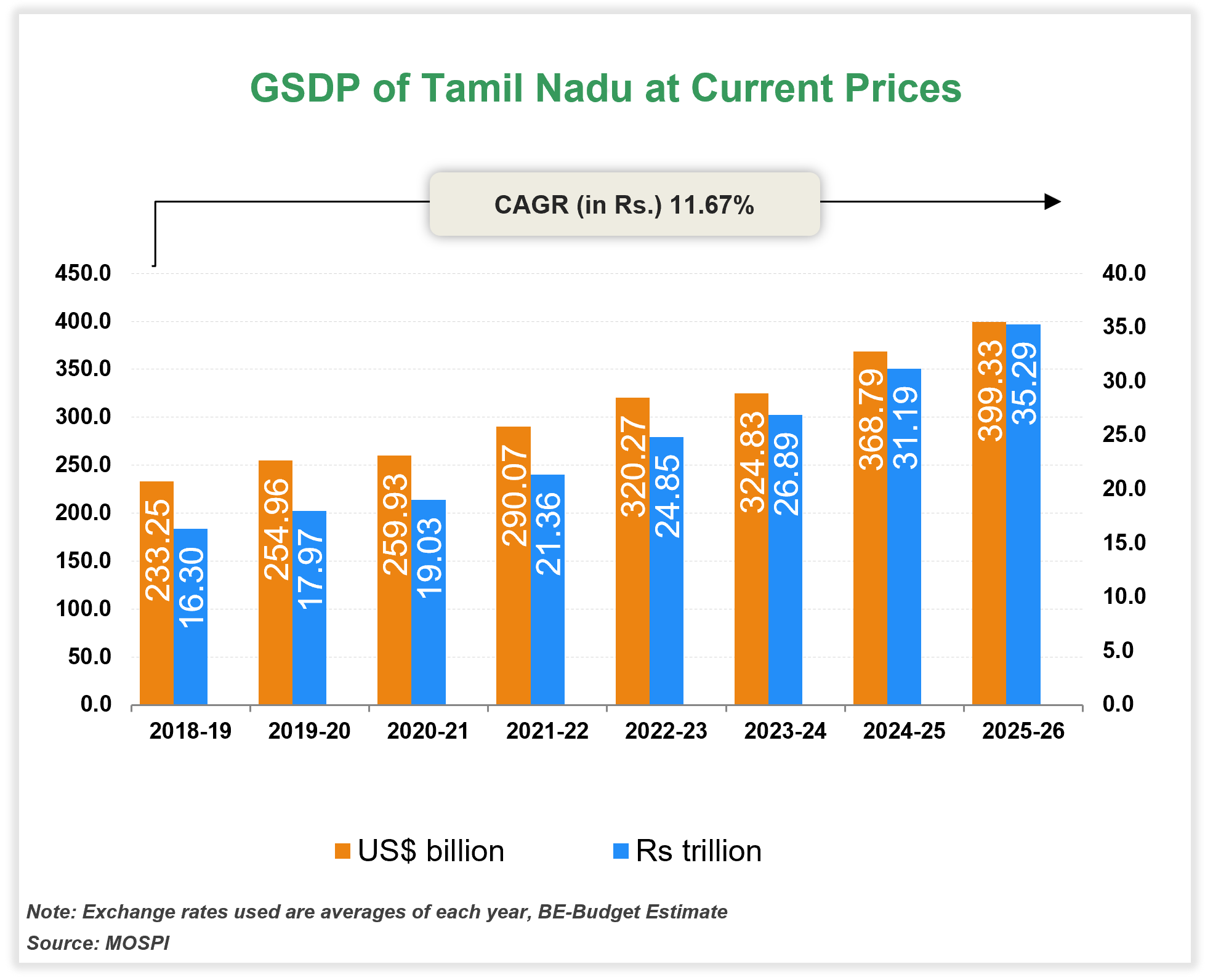
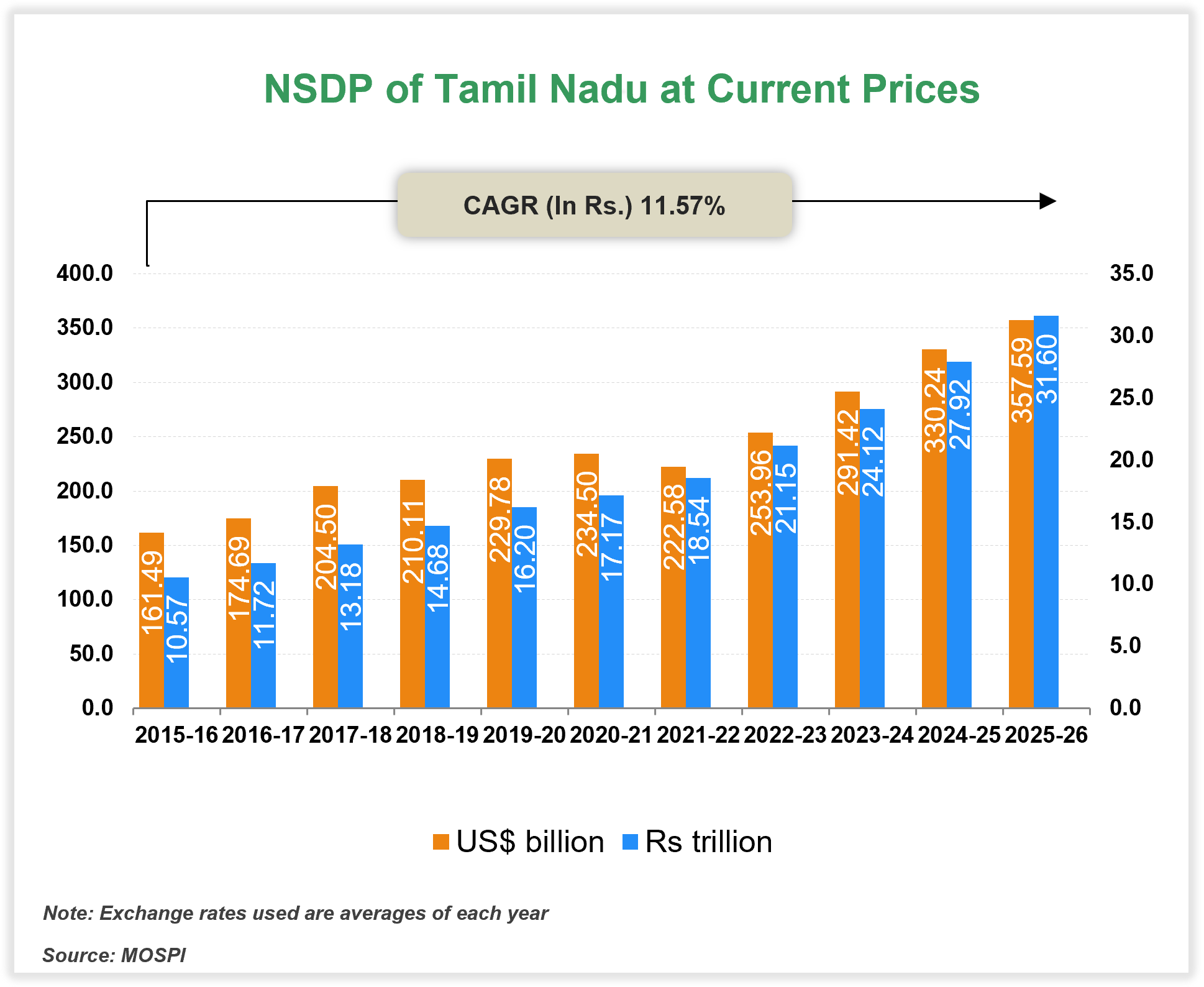
At current prices, Tamil Nadu’s gross state domestic product (GSDP) is estimated to be Rs. 35.29 trillion (US$ 399.33 billion) in FY26. The state’s GSDP to increase at a CAGR of 11.67% between FY19 and FY26.
As of April 2026, the state had a total installed power generation capacity of 47.92 GW.
Thermal power contributed 17,013.25 MW to the total installed power generation capacity, followed by renewable power (27,257.39 MW), hydropower (2,203.20 MW) and nuclear power (1448.00 MW).
Private sector, with a capacity of 32,954.05 MW, was the biggest contributor to the total installed power generation capacity in Tamil Nadu, followed by state utilities 8,112.43 MW and central utilities 6,855.36 MW.
According to DPIIT, cumulative FDI inflow in Tamil Nadu stood at Rs. 1,56,544 crore (US$ 19.34 billion) between October 2019 to March 2026. The state ranked fifth in India in terms of FDI inflows.
Total merchandise exports from the state stood at Rs. 5,24,382 crore (US$ 59.30 billion) billion in FY26.
The state exported key items such as Engineering Goods, Electronic Goods, Ready-made garments of all textiles, Cotton Yarn/Fabs/Madeups, Handloom Products, Leather and Leather Manufactures and Gems and Jewellery.
According to the Telecom Regulatory Authority of India (TRAI), Tamil Nadu had 80.51 million wireless and 3.96 million wireline subscribers, as of March 2026.
Tamil Nadu had a high tele-density of 107.89%, as of March 2026.
Some of the major initiatives taken by the Government to promote Tamil Nadu as an investment destination are:
- The Tamil Nadu government approved and laid the foundation stones for three new TIDEL Neo Mini IT Parks in the state. Located in Karur, Nagapattinam, and Pudukkottai, these facilities are designed to decentralize IT opportunities, support local start-ups, and generate up to 1,800 direct jobs.
- On September 6, 2025, the Government of India announced an allocation exceeding Rs. 93,000 crore (US$ 11.20 billion) for major port-infrastructure projects in Tamil Nadu, signalling a strong commitment to strengthening maritime connectivity, boosting trade and supporting regional economic growth.
- On August 15, 2025, the Tamil Nadu Government approved industrial projects worth Rs. 1,937 crore (US$ 218 million) expected to create 13,409 jobs, across sectors including electronics manufacturing, engineering design, technical textiles, renewable energy R&D, information technology and food & agri-tech.
- On June 29, 2025, the Tamil Nadu Government approved a Rs. 8,000 crore (US$ 902 million) investment under the Mudalvarin Grama Saalaigal Membattu Thittam (MGSMT) to upgrade 20,000 km of rural roads. Already 12,572 km across 9,690 projects have been completed at a cost of Rs. 4,609 crore (US$ 519 million) and another 6,671 km is in progress with Rs. 3,529 crore (US$ 397 million) sanctioned.
- The Chengalpattu district in Tamil Nadu is set to host a new biotech industrial park, with the Tamil Nadu Industrial Development Corporation (TIDCO) inviting bids to create its master plan and detailed project report. The facility will cater to advanced manufacturing, research collaborations and biotech-specific infrastructure across pharmaceuticals, vaccines, biologics, agritech and marine biotech.
- Budget allocations for FY27
- Rs.21,132 crore (US$ 2.30 billion) has been allocated for the highways sector to strengthen road connectivity and transport infrastructure across the state.
- Rs.22,457 crore (US$ 2.44 billion) has been earmarked as assistance to power utilities, including subsidies for agricultural and domestic consumers, share capital assistance and loans.
- Rs.1,000 crore (US$ 108.7 million) has been allocated under the Kalaignar Nagarpura Membattu Thittam, while Rs.500 crore (US$ 54.3 million) has been earmarked for the Singara Chennai 2.0 initiative to support urban infrastructure development.
- Rs.57,039 crore (US$ 6.20 billion) has been allocated to the education sector, the largest sectoral allocation in the FY27 budget.
- Rs.22,090 crore (US$ 2.40 billion) has been allocated to the health sector to strengthen healthcare infrastructure and public health services across Tamil Nadu.
- SIPCOT (State Industries Promotion Corporation of Tamil Nadu Limited) will develop an Integrated Textile Park, spanning 111 Acres in Salem district with an estimated investment of Rs. 800 Crore (US$ 96.62 million).
- A 3-storey industrial complex, spanning 5 Acres will be developed at Sakkimangalam Industrial Estate in Madurai district by TANSIDCO (Tamil Nadu Small Industries Development Corporation Limited) at Rs. 118 crore (US$ 14.25 million).
Tamil Nadu is one of India’s most industrialised and export-oriented states, with a large, diversified manufacturing base spanning automobiles, electronics, textiles, engineering, pharmaceuticals and leather. With a GSDP of US$ 399.33 billion in FY26 and strong FDI inflows, the state is a major contributor to India’s exports, supported by world-class infrastructure including extensive road and rail networks, major ports, airports and a robust power system led by renewable energy. Continued policy support for manufacturing, IT, GCCs, agriculture, logistics and urban development, alongside sustained public investment, positions Tamil Nadu as a leading engine of industrial growth, innovation and global trade in India.