EXECUTIVE SUMMARY
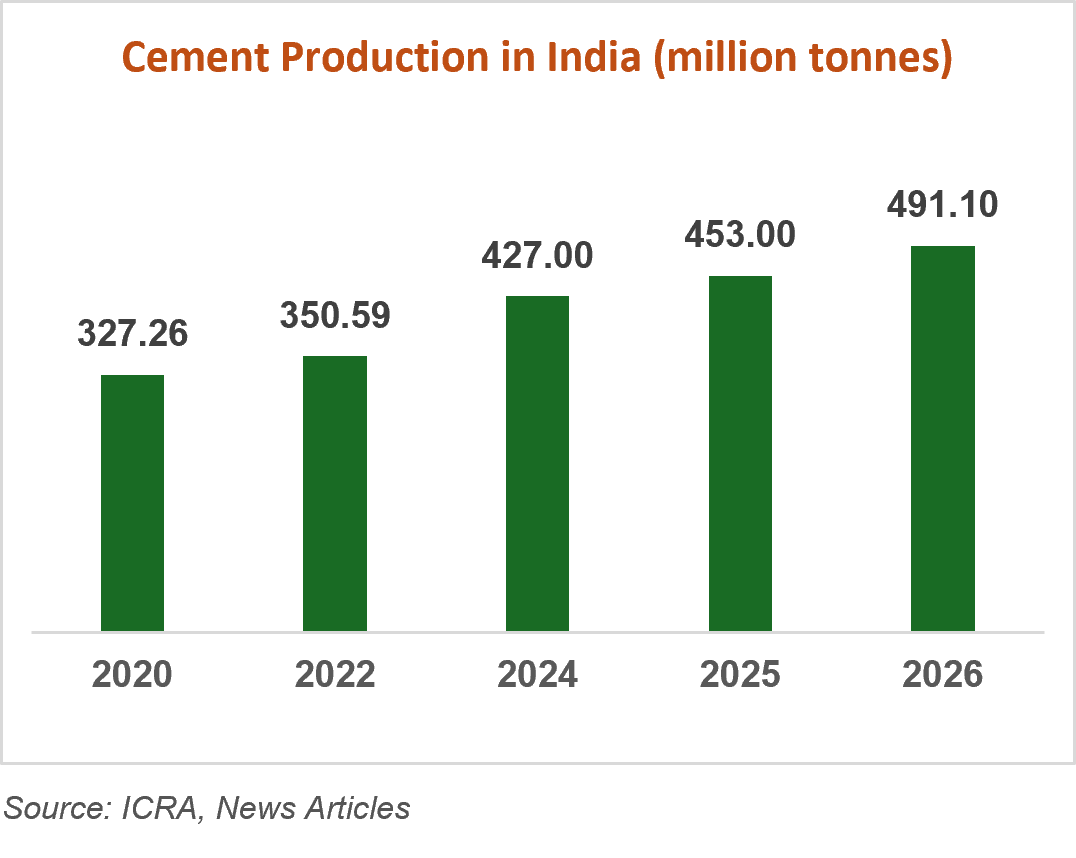
India's cement production volumes rose 8.60% year-on-year (YoY) to 491.70 million metric tonnes (MT) in FY26 and grew 8.80% YoY to 130.20 million MT in Q1 FY27. ICRA expects volume growth to moderate to 6-7% in FY27, supported by sustained demand from the housing and infrastructure sectors.

Production (FY26)
491.70 MMT

Growth (FY26)
8.60%

Q1 FY27 Production
130.20 MMT

Growth Outlook (FY27)
6-7%
Introduction
India is the second-largest cement-producing country in the world and contributes to more than 8% of the total capacity in the world. Majority of the companies dealing with cement business are privately owned, and 98% of the total capacity in cement business belongs to the private sector. Leading 20 companies account for about 70% of total production.
Products produced by India include grey cement, white cement, ready-mix concrete (RMC), and clinker. Products produced by it include OPC, PPC, PSC and PCC. It is amongst the most environmentally friendly cement manufacturing companies in the world. It is also one of the most energy efficient in cement manufacturing in the world.
Demand for cement in India is driven by construction. Over 65% of the total consumption of cement in India is accounted for by housing and real estate as well as government backed construction projects of roads, railways, and industrial corridors.
MARKET SIZE AND GROWTH
- India's cement production volumes rose 8.60% YoY to 491.70 million MT in FY26 from 453 million MT in FY25
- Production grew 9.80% YoY to 44.80 million MT in June 2026 and 8.80% YoY to 130.20 million MT in Q1 FY27.
- ICRA expects volume growth to moderate to 6-7% in FY27, with operating profit before interest, depreciation, tax and amortisation (OPBIDTA) projected at Rs. 820-870 (US$ 8.66-9.19) per MT and a stable sector outlook.
- The industry added around 43 million tonnes per annum (MTPA) of capacity in FY26 and is expected to add another 30-34 MTPA in FY27.s
- The industry is projected to grow at a CAGR of 5.10% from 2025 to 2030, reaching an installed capacity of 850 MTPA by 2030 and 1,350 MTPA by 2050.
KEY SEGMENTS
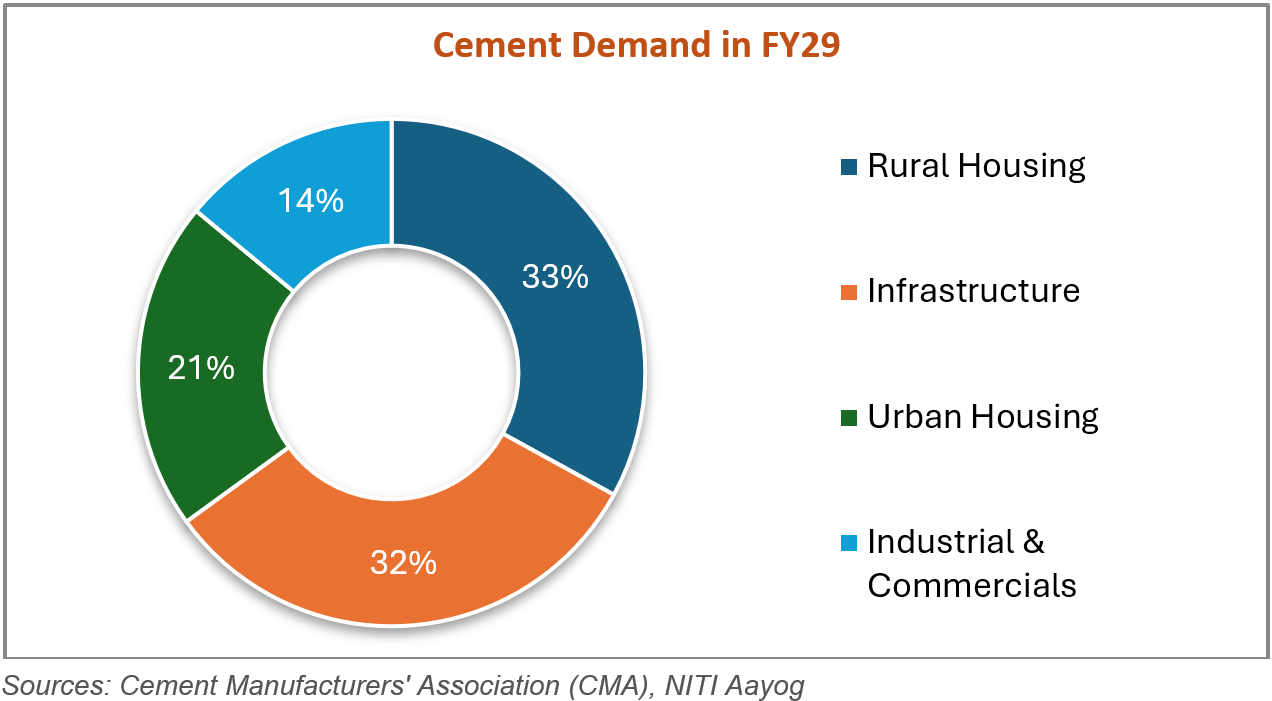
Demand is fuelled by building houses, infrastructures, and industries, whereas installed capacity is largely confined to the South and East regions.
INVESTMENTS AND FDI
- FDI Inflows for production of cement and gypsum products stood at Rs. 52,400.86 crore (US$ 8,062.12 million) from April 2000 to March 2026.
- The leading companies are estimated to make investments worth Rs. 1.20 lakh crore (US$ 13.53 billion) from FY26 to FY28, which is around 50% more than the last three years.
- Odisha sanctioned projects by NCL Industries and Dalmia Cement each worth Rs. 2,000 crore (US$ 0.23 billion) each and are expected to generate around 2,000 jobs, whereas Karnataka sanctioned projects worth Rs. 17,183 crore (US$ 2.01 billion) and are estimated to create 12,500 jobs.
- UltraTech Cement has made capital investments worth Rs. 9,600 crore (US$ 1,086.34 million), while JSW Cement is supporting its growth through an IPO worth Rs. 3,600 crore (US$ 408 million).
GOVERNMENT INITIATIVES
- Union Budget 2026-27: Public capital expenditure was raised 11.40% to Rs. 12.20 lakh crore (US$ 138.04 billion), with an Infrastructure Risk Guarantee Fund proposed to strengthen private developer confidence.
- Transport corridors: The Budget announced seven high-speed rail corridors, a dedicated freight corridor and 20 new national waterways.
- Roads: Ministry of Road Transport and Highways was allocated Rs. 3,09,875 crore (US$ 35.06 billion), marking an approximate 8% increase over the previous budget.
- Railways: Indian Railway approved projects worth over 6,000 km network and a proposed investment of Rs. 1.53 lakh crore (US$ 17.31 billion). • Pradhan Mantri Awaas Yojana-Gramin (PMAY-G): An allocation of Rs. 54,916.70 crore (US$ 6.21 billion) was allocated for the year 2026-27 for housing in rural areas.
- PMAY-Urban 2.0: Allocation for one crore households belonging to urban poor and middle class over five years with up to approximately Rs. 2.50 lakh (US$ 2,800) assistance to each qualifying household.
- Bulk cement in roads: It is proposed that the Government will use bulk cement instead of bitumen in all road constructions as it is more durable and cost-effective to maintain cement.
- National Council for Cement and Building Materials (NCB): MoUs have been signed with the Global Cement and Concrete Association (GCCA) India in Net Zero Research, and AIC-Plasmatech in Thermal Plasma Torch Technology.
DRIVERS AND OPPORTUNITIES
- Real estate - to the Confederation of Real Estate Developers' Associations of India (CREDAI), the real estate sector is projected to reach Rs. 112 lakh crore (US$ 1.30 trillion) by FY34 and Rs. 449 lakh crore (US$ 5.17 trillion) by 2047, whereas the growth in affordable housing is quite quick in Tier-II and Tier-III cities.
- Infrastructure megaprojects - The 508-km-long Mumbai-Ahmedabad Bullet Train Corridor consumes 20,000 cubic metres of cement a day, which is equal to eight 10-storey buildings, and involves 20,000 workers each day.
- Industrial development - Economic expansion would support robust performance in the industrial sector, which, in its turn, would ensure demand sustainability.
- Export capacity - There is tremendous export potential for clinker and grey cement in countries in the Middle East, Africa, and other developing countries from the coastal plants at Gujarat and Visakhapatnam. The total exports of cement, clinker and asbestos cement goods were US$ 685.12 million during FY25.
STRATEGIES
- Capacity expansion - Ambuja Cements plans to reach 140 MTPA by FY28, Dalmia Bharat at 75 MTPA by FY28, Shree Cements more than 80 MTPA by FY28, while UltraTech Cements intends to increase capacity by 15.90 MTPA in FY27 and an additional 29.80 MTPA in FY28.
- Technology for low carbon footprint - In June 2026, Ambuja Cements collaborated with Leilac Limited to initiate a project that has the capability of capturing more than one million tonnes of carbon dioxide per year at their plant at Sanghipuram in Gujarat after being chosen in December 2025 as the first Indo-Swedish carbon capture and utilisation project in the global cement sector.
- Alternate fuels and renewable energy - The Alathiyur cement manufacturing unit of Madras Cement uses coffee husk and cashew shell as an alternate fuel, saving about US$ 1.70 million a year. The Arasmeta cement manufacturing plant of Lafarge saves 10% of the kiln coal consumption by using rice husk. The green energy installed capacity of UltraTech Cement was 1,806 MW in FY26, meeting about 41% of its power requirements.
- Diversification and premiumisation - Shree Cement increased their premium product share to 22% of total volume of trade, while UltraTech Cement has committed Rs. 1,800 crore (US$ 203.83 million) to build a wire and cable plant in Bharuch, Gujarat by December 2026.
M&A
- Consolidation is rapidly gaining pace: The leading ten companies acquired 140 MT of capacity during the past five years, amounting to an investment of Rs. 89,000 crore (US$ 10.40 billion), with UltraTech Cement and Ambuja Cements being the front runners.
- The merger of Penna Cement by Ambuja Cements was achieved in April 2026 with the approval from NCLT after reaching an agreement of Rs. 10,422 crore (US$ 1.24 billion).
- Sanghi Industries' merger with Ambuja Cements was approved by the NCLT in February 2026, while Ambuja approved the amalgamation of ACC Limited and Orient Cement Limited into itself in December 2025.
- Some of the companies that have expressed interest in buying a 69.39% shareholding of HeidelbergCement India worth approximately Rs. 3,437 crore (US$ 412 million) include Ambuja Cements, UltraTech Cement, JSW Group and Dalmia Bharat.
TRENDS
- Expansion of the base of players - More players in the form of small and mid-sized cement firms are emerging in all regions.
- Expansion in the region - The eastern and southern parts have the potential for leading expansion of capacities, with about 39-44 MTPA expected in FY27-FY28.
- Green cement and blended cement - The Navrattan Group plans to bring out Green Cement, while Heidelberg Materials India says that more than 97% of its cement production is from blended cement, with alternative fuel consumption at 11% in FY26.
- RMC - The firms are attempting to establish a niche market for RMC.
- Regional pricing - Prices for cement in the Western region have increased by around Rs. 5 per bag in April 2026, whereas in the Southern region, there is an increase of around Rs. 23 per bag month-on-month, according to PL Capital's May 2026 update.
Road Ahead
- July 2026 : Cement reported its highest-ever first-quarter consolidated grey cement sales volume of 41.31 million tonnes in Q1 FY27, with domestic grey cement volumes up 13.10% YoY to 39.20 million tonnes.
- July 2026 : ACC Limited reported sales volumes of 10 million tonnes in Q1 FY27 and commenced trial operations at its 2.40 MTPA Salai Banwa grinding unit in Uttar Pradesh.
- June 2026 : Dalmia Bharat commenced the first cement dispatch from its newly acquired 2.50 MTPA Chunar grinding unit in Uttar Pradesh.
- May 2026 : Ambuja Cements commissioned a 3 MTPA clinker line at its Jodhpur plant and began trial operations of the 1.20 MTPA Dahej Grinding Unit Line 2.
- February 2026 : Shree Cement commissioned a 3.65 MTPA clinkerisation line at its Kodla integrated cement plant in Karnataka.
- February 2026 : JSW Cement approved a new 1.65 MTPA grinding unit in Fujairah, UAE, at a capital cost of US$ 39 million.
FAQs
The industry includes manufacturing of grey cement, white cement, clinker, and ready-mixed concrete. The cement industry's importance stems from its connection with the housing and infrastructure industries, which drive the process of construction.
The major type of cement in India includes OPC, PPC, PSC and PCC, blended cement, white cement and ready-mix concrete and green cement is currently being manufactured.
Some of the growth drivers include housing and real estate, infrastructure spending by the government, affordable and rural housing schemes, urbanization and industry.
Major cement producers in India are Rajasthan, Andhra Pradesh, Telangana, Karnataka, Gujarat, Tamil Nadu and Maharashtra.
These include limestone and gypsum, including synthetic gypsum and fuels such as coal and alternative fuels such as rice husks and tire chips.
It provides projects including the Mumbai-Ahmedabad Bullet Train Corridor, roads, railways and housing projects, and cement is being used to replace bitumen in roads projects.
The measures include higher Union Budget capital expenditure, PMAY-G, PMAY-Urban 2.0, transport corridors, and bulk cement in roads.
The producers are implementing alternate energy sources, renewable energy, waste heat recovery, and carbon capture technologies with zero emissions by 2050.
The sector is projected to continue expanding due to housing and infrastructure needs, increase capacity, and become a prospective exporter into the international market.
Related News
MORECement Clusters
- Rajasthan
- Tamil Nadu
- Andhra Pradesh
- Madhya Pradesh
- Chhattisgarh
- Odisha


IBEF Campaigns
MORE

Case Studies
MOREContainerisation: Transforming India's Maritime Trade
Despite other modes of transportation, the maritime shipping mode is the backbone of international trade. The concept of containerisation has revoluti...
India’s Growing Senior Care Needs: New Businesses and Services

The current state of India is characterised by the process of demographic transition with gradual growth of the proportion of senior citizens within t...
The Rise of India's Pathology Laboratories: Strengthening Quality and Safety in Healthcare

India has seen its healthcare system witness an impressive evolution in the last two decades because of the growth in healthcare infrastructure, incre...
IBEF BLOG
MORE
India's Blue Economy: Untapped Potential in Ports, Fisheries and Ocean Resources
The maritime space of India, which comprises the coastline, island areas, a...
How Technology Is Making Waste Management More Efficient in Indian Cities
Indian cities are adopting digital monitoring, sensors, and automated waste...
India's Cold Chain Logistics: The Backbone of Perishable Trade
India's cold chain network allows the transfer of perishables from farm...
Partners