Advantage India
Robust
Demand
*In FY26 (April-July 2025), finished steel production stood at 51.46 MT.
*India’s domestic steel demand is estimated to grow by 9-10% in 2025 as per ICRA.

Increasing
investments
*To achieve steel capacity build-up of 300 MT per annum by 2030, India would need to invest US$ 156.08 billion by 2030-31.
*On July 31, 2025, SAIL has approved a Rs. 7,500 crore (US$ 875 million) capex for FY26, marking a 25% increase over the previous year, to expand capacity across its integrated plants, aiming to scale up to 35 MT per annum by 2030.

Policy
Support
*In February 2024, The government has implemented various measures to promote self-reliance in the steel industry.
*Under the Union Budget 2023-24, the government allocated Rs. 70.15 crore (US$ 8.6 million) to the Ministry of Steel.

Competitive
Advantage
*In FY26 (April-July 2025), crude steel production in India stood at 54.19 MT.
*Easy availability of low-cost manpower and presence of abundant iron ore reserves make India competitive in the global set up.
*As of April 2025, India has huge iron ore reserves and can produce 700 MT per year and has the potential to be the second largest producer of iron ore globally.

Introduction
One of the primary forces behind industrialization has been the use of metals. Steel has traditionally occupied a top spot among metals. Steel production and consumption are frequently seen as measures of a country's economic development because it is both a raw material and an intermediary product. Therefore, it would not be an exaggeration to argue that the steel sector has always been at the forefront of industrial progress and that it is the foundation of any economy. The Indian steel industry is classified into three categories - major producers, main producers, and secondary producers.
India is the world’s second-largest producer of crude steel, with an output of 151.14 MT of crude steel and finished steel production of 145.30 MT in FY25.
India’s domestic steel demand is estimated to grow by 9-10% in 2025 as per ICRA.
The growth in the Indian steel sector has been driven by the domestic availability of raw materials such as iron ore and cost-effective labour. Consequently, the steel sector has been a major contributor to India's manufacturing output.
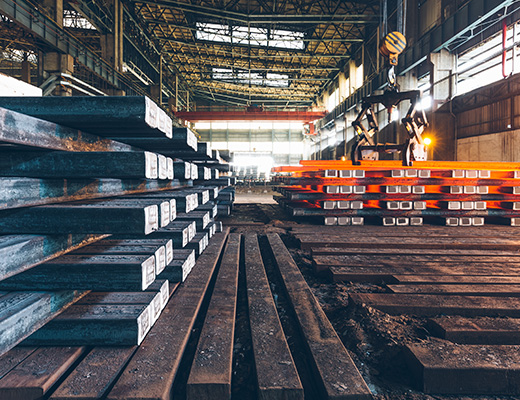
The Indian steel industry is modern, with state-of-the-art steel mills. It has always strived for continuous modernisation of older plants and up-gradation to higher energy efficiency levels.
Market Size
In the past 10-12 years, India's steel sector has expanded significantly. Production has increased by 75% since 2008, while domestic steel demand has increased by almost 80%. The capacity for producing steel has grown concurrently, and the rise has been largely organic.
In FY26 (April-July 2025), the consumption of finished steel stood at 51.45 MT.
In FY25, the consumption of finished steel stood at 150.23 MT.
In FY26 (April-July 2025), finished steel production stood at 51.46 MT.
In FY26 (April-July 2025), crude steel production in India stood at 54.19 MT.
Share of Secondary steel plants including MSMEs in crude steel capacity in FY25 stood at 47%.
India’s steel production capacity increased to 200.33 MT in FY25, and the figure is anticipated to rise to 300 MT by FY30.
As of April 2025, India has huge iron ore reserves and can produce 700 MT per year and has the potential to be the second largest producer of iron ore globally.
In FY26 (April-July 2025), the exports and imports of steel stood at 1.7 MT and 1.67 MT, respectively.
In FY25, the exports and imports of steel stood at 4.85 MT and 9.53 MT, respectively.
Top five exported products in FY26 (April-July 2025) were: GP/GC Sheets/Coil, HR Coil/Strip, Pipes, Bars & Rods, CR Coil/Sheets.

As of July 30, 2025, India’s green steel demand is forecasted to climb from negligible levels today to 4.49 million tonnes (MT) by FY30, driven by the construction sector, infrastructure and automobiles with projections rising to 24 MT by FY35, 73 MT by FY40 and peaking at 179 MT by FY50.
Investments
The steel industry and its associated mining and metallurgy sectors have seen major investments and developments in the recent past.
- According to the data released by the Department for Promotion of Industry and Internal Trade (DPIIT), between April 2000 to June 2025, Indian metallurgical industries attracted FDI inflows of Rs. 1,60,000 crore (US$ 18.67 billion).
Some of the major investments in the Indian steel industry are as follows:
- On March 28, 2025, AM/NS India has secured 890 hectares of land in Rajayyapeta, Anakapalli district, Andhra Pradesh for a new integrated steel mill with planned capacity of about 7 MTPA of crude steel, expanding beyond its Hazira operations to meet rising domestic demand.
- On July 7, 2025, Tata Steel signed a Memorandum of Understanding with Australia’s InQuik Group to bring modular bridge construction technology to India, using prefabricated steel formwork filled with concrete on site to enable faster, cost-effective, climate resilient and scalable bridge infrastructure, especially useful in remote regions.
- As of August 2025, JSW Steel and Japan’s JFE Steel are planning to jointly invest Rs. 5,845 crore (US$ 682 million) to expand capacity for cold-rolled grain-oriented electrical steel (CRGO) to 3,50,000 tonnes per annum by FY28 by scaling up the Nashik plant from 50,000 to 2,50,000 TPA and increasing the Vijayanagar unit’s capacity to 1,00,000 TPA.
- On August 18, 2025, JSW Steel and South Korea’s POSCO signed a non-binding Heads of Agreement to explore setting up a 6 MTPA integrated steel plant in India via a 50:50 joint venture with Odisha among the key locations under consideration. Feasibility studies, resource availability and investment terms yet to be finalised.
- Under the second round of the Production Linked Incentive scheme (PLI) for specialty steel, 25 companies committed Rs. 17,000 crore (US$ 1.98 billion) to produce high-end steel domestically, aiming to reduce imports and boost self-reliance. The scheme targets five key steel product categories with applications across various industries like automobiles and transformers.
- India and Japan held the third Steel Dialogue on Feb 4, 2025, in New Delhi, discussing economic trends, steel trade, and industry developments. India highlighted policy initiatives, green steel efforts, and investment opportunities for Japan.
- In February 2025, during the Bengal Global Business Summit, about 50% of the Rs. 26,000 crore (US$ 3.02 billion) investment proposals received by Jharkhand government in Kolkata pertain to the steel sector.
- In February 2025, JSW Group announced a Rs. 1,00,000 crore (US$ 11.60 billion) investment to set up a 25 MT steel plant in Maharashtra's Gadchiroli district over seven to eight years. The project, expected to be the world's largest and most eco-friendly, will drive economic growth and job creation in Vidarbha.
- In February 2024, The JSW Group is set to build a steel plant in Jagatsinghpur, Odisha, with an investment of US$ 7.8 billion (Rs. 65,000 crore). The plant will have a production capacity of 13.2 million tons of steel per year and is expected to create 30,000 jobs.
- In February 2024, JSW Steel plans to establish a joint venture with Japan's JFE Steel Corporation in a 50:50 partnership to invest US$ 661.9 million (Rs. 5,500 crore) in setting up a plant in Karnataka.
- In January 2024, according to Mr. Lakshmi Mittal, Gujarat will host the world's largest steel manufacturing site by 2029 at the Vibrant Gujarat Summit
Government Initiatives
Some of the other recent Government initiatives in this sector are as follows:
- Indian government plans to reduce imports by 50% in FY26 to become net exporter of steel in the near future. The Directorate General of Trade Remedies (DGTR) has recommended a 12% provisional safeguard to protect domestic players from surge in imports and potentially increasing their profitability. This development could potentially lead to a decrease in imports and increase market competitiveness.
- Up to December 2024, RINL dispatched about 1,400 MT of steel to Northeast projects, including National Highways Authority of India (NHAI) and National Highways and Infrastructure Development Corporation Limited (NHIDCL). Plans are in progress to set up a two-tier steel distribution network in Guwahati.
- Union Minister Mr. H. D. Kumaraswamy launched Steel Import Monitoring System 2.0 (SIMS 2.0) on July 25, 2024. SIMS 2.0 improves data transparency, quality control, and integration with government portals to support steel sector growth and better import management.
- The Union Ministry of Steel launched PLI Scheme 1.1 on January 6, 2025, with a Rs. 6,322 crore (US$ 733.40 million) outlay to boost specialty steel production and attract investments. Covering five key product categories, the scheme eases norms to reduce imports, enhance domestic manufacturing, and improve energy efficiency, with applications open until January 2025.
- In February 2024, the government has implemented various measures to promote self-reliance in the steel industry.
- In July 2021, the Union Cabinet approved the production-linked incentive (PLI) scheme for specialty steel. The scheme is expected to attract investment worth ~Rs. 400 billion (US$ 5.37 billion) and expand specialty steel capacity by 25 million tonnes (MT), to 42 MT in FY27, from 18 MT in FY21.
- Under the Union Budget 2023-24, the government allocated Rs. 70.15 crore (US$ 8.6 million) to the Ministry of Steel.
- In addition, an investment of Rs. 75,000 crore (US$ 9.15 billion) (including Rs. 15,000 crore (US$ 1.83 billion) from private sources) has been allocated for 100 critical transport infrastructure projects for last and first mile connectivity for various sectors such as ports, coal, and steel.
- The Union Cabinet, Government of India approved the National Steel Policy (NSP) 2017, as it intends to create a globally competitive steel industry in India. NSP 2017 envisage 300 million tonnes (MT) steel-making capacity and 160 kgs per capita steel consumption by 2030-31.
- The Ministry of Steel is facilitating the setting up of an industry driven Steel Research and Technology Mission of India (SRTMI) in association with the public and private sector steel companies to spearhead research and development activities in the iron and steel industry at an initial corpus of Rs. 200 crore (US$ 30 million).
- The Government of India raised import duty on most steel items twice, each time by 2.5% and imposed measures including anti-dumping and safeguard duties on iron and steel items.
Road Ahead
The steel industry has emerged as a major focus area given the dependence of a diverse range of sectors on its output as India works to become a manufacturing powerhouse through policy initiatives like Make in India. With the industry accounting for about 2% of the nation's GDP, India ranks as the world's second-largest producer of steel and is poised to overtake China as the world's second-largest consumer of steel. Both the industry and the nation's export manufacturing capacity have the potential to help India regain its favourable steel trade balance.
The National Steel Policy, 2017 envisage 300 million tonnes of production capacity by FY31. The per-capita consumption of steel stood at 100 kgs in FY26 (April-August 2025) and the National Steel Policy aims to increase it to 160 kgs by FY31. While, in FY23, per capita consumption of steel in rural India was estimated to be between 21.3 kg per annum.
Huge scope for growth is offered by India's comparatively low per capita steel consumption and the expected rise in consumption due to increased infrastructure construction and the thriving automobile and railways sectors.
Note: Conversion rate used in July 2025, Rs. 1 = US$ 0.011
References: Media reports, press releases, Press Information Bureau (PIB), Joint Plant Committee (JPC), Union Budget 2023-24, DPIIT, Ministry of Steel
Related News
MOREStates with the Highest Steel-Producing Capacity in India
- Odisha
- Chhattisgarh
- Jharkhand
- Karnataka

Posters
MORE
PROVEN METTLE IN STEEL
India is tyhe world's largest producer of crude steel, and is currently doubling its production capacity.
IBEF Campaigns
MORE

Aatmanirbhar Bharat Utsav 2024
Union Minister of External Affairs, Dr. S. Jaishankar and Union Commerce an...
Case Studies
MOREStyling India’s Growth: The Indian Salon Landscape

India’s beauty salon market is now undergoing a very radical makeover of its own. Earlier considered by many merely a seasonal trip for wedding ...
How Technology and Digitalisation Are Reshaping the Indian Aviation Industry

India’s aviation sector is growing at a highly accelerated speed. Today, it is the world’s third-largest civil aviation market. Fuelled by...
India’s Floriculture Sector: Blooming with Export Potential and Rural Prosperity

India’s floriculture sector is evolving into a globally competitive industry, offering vast potential in rural income generation, export diversi...
IBEF BLOG
MORE
Revival of India’s Forgotten Superfoods: Jackfruit, Amaranth and Moringa in Global Diets
For centuries, Indian kitchens have been home to an incredible diversity of...

Next-Gen GST: Powering India’s Investment and Demand Surge
India’s recent Goods and Services Tax (GST) overhaul is more than a s...

Transforming Spaces: The Growth and Opportunities in India’s Home Décor Industry
India’s home décor industry is evolving into one of the most d...
Partners




